

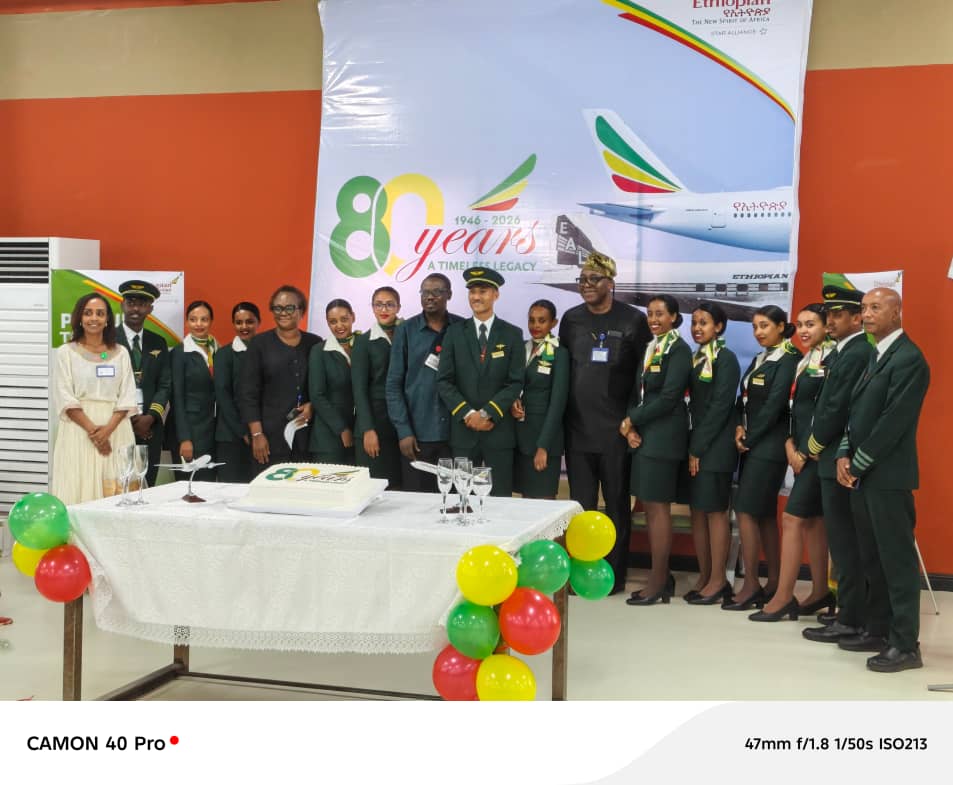
Ethiopian Airlines (ET) celebrated its 80th anniversary in Lagos, positioning the milestone as both a retrospective on African aviation development and a forward-looking commitment to innovation, sustainability, and market depth in Nigeria.
General Manager (GM) Ethiopian Airlines Nigeria, Mrs. Firihiewot Mekonnen, traced the carrier’s origins to April 8, 1946, when “a single flight departed from Addis Ababa bound for Cairo, carrying with it not just passengers, but the bold promise of African aviation aboard a Douglas C-47 aircraft.” She added that though the airline’s beginning was humble, it was driven by unwavering commitment, vision, and dedication.
According to Mrs. Mekonnen, the Group now operates as an entire aviation ecosystem, integrating passenger and cargo transport, MRO, ground services, Ethiopian Airports, an Aviation University, in-flight catering, and the Ethiopian Skylight Hotel. The vertically integrated model supports operational control across dispatch reliability, maintenance planning, and ancillary revenue optimization. From an initial fleet of five C-47s and one international route, the airline has scaled to a fleet of more than 140 ultra-modern aircraft and still expanding, serving 144 destinations globally.
ET entered the Nigerian market in 1960, just a month after Nigeria’s independence, and has maintained continuous service for 65 years. “Through every season through growth and challenge, through change and progress we have never stopped flying,” Mrs. Mekonnen stated, emphasizing that “Nigeria is not just a destination in our network it is a valued partner in our journey.” She stressed the carrier’s commitment to innovation, sustainability, and delivering experiences to its passengers that align with ICAO’s Long-Term Aspirational Goal and industry-wide efficiency targets. The Lagos station remains a strategic West African node for passenger throughput, cargo uplift, and regional connectivity.
Industry analysts point to the operator’s diversified group structure and fleet modernization as key differentiators in maintaining yield and load factor performance across long-haul and intra-African sectors. While specific SAF adoption or fleet-renewal metrics were not disclosed at the event, the Group’s continued induction of new-generation aircraft supports improved fuel-burn economics and emissions compliance.
“This achievement belongs to all of us it is truly a shared success,” Mrs. Mekonnen said, framing the anniversary as “a renewed commitment to an even brighter future” for stakeholders in Nigeria and across the carrier’s network.