

“Airborne already? Wow.”
That was the exact thought that flashed through my mind as I looked out the panoramic window. I hadn’t felt the violent jolt or stomach-drop I always associated with helicopters in movies. In fact, I hadn’t even realized our wheels had left the tarmac until the ground began to shrink beneath us. This was my very first time flying in a helicopter, and it was happening aboard the maiden flight of Africa’s first Airbus H160.
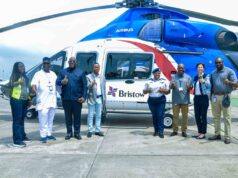
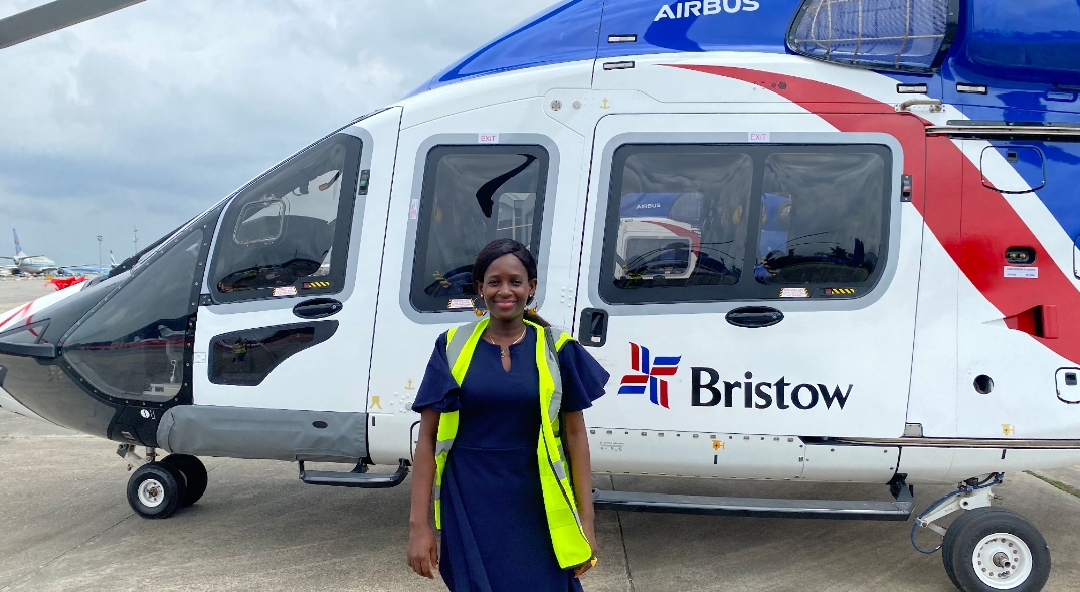
On Thursday, July 2, 2026, I had the incredible privilege of being among the first to fly on the first-ever Airbus H160 deployed in Africa. Bristow Helicopters, the launch customer of the aircraft type on the continent, procured five of these helicopters. By the time of this flight, the airline had taken delivery of four of the vessels, and I flew aboard the one bearing the registration number 5N-CFN.
To be honest, I did not know what to expect on this flight. I frequently fly on commercial jets and can recite those motions in my sleep, but this particular experience took me completely off guard.
As I took my seat, it felt like I was in a premium airline cabin, just with a much better, unobstructed view. Waiting for me right on the seat was a pair of bright yellow, heavy-duty headphones. These, I assumed, were a standard precaution to shield my ears from the deafening engine roar. I slipped them on as the engines began to spool up, but curiosity got the better of me. I lifted them up just for a moment to hear what the aircraft really sounded like, only to quickly pull them back down again because the raw noise without them felt absolutely deafening to my unaccustomed ears.
Our captain later explained that the aircraft model was actually designed to keep external noise to an absolute minimum, so I suspect my intense reaction was simply because it was my first time on a helicopter. Yet, once the yellow headsets were firmly back in place, they worked in perfect tandem with the aircraft’s advanced sound insulation to instantly pull me back into a remarkably quiet, peaceful bubble.
Looking around the cabin, the first clue that this was a completely different class of travel was the seat belt. Unlike the simple, loose lap belts found on standard commercial jets, which I find really uncomfortable because the pressure sits solely on my thighs, the H160 equips passengers with a robust, multi-point shoulder harness system. This four-point harness secures both your lap and shoulders, effectively hugging you into your seat. Strapping into it felt less like boarding an airliner and more like stepping into a high-performance spacecraft, providing an immediate sense of absolute security. That structural trust was fully vindicated just moments later when we slipped into the air so smoothly that my initial disbelief melted into pure awe.
The heavy-duty restraint system on the aircraft is standard for offshore energy logistics, ensuring maximum passenger safety during dynamic maneuvers or unexpected turbulence over the ocean. Yet, despite looking heavy-duty, the harness is engineered to be lightweight and comfortable, and allowed me to easily turn and look out the panoramic windows.
Strapping into the harness wasn’t the only surprise; the seat itself was a revelation. As someone who isn’t tall, I dread commercial jet seats. Their plump, bulky headrests invariably push my head forward at an awkward angle, leaving my neck strained. In this position, not even a travel pillow eases my discomfort. But the H160 features a brilliant, minimalist choice: an open-frame, hollow headrest. Engineered primarily to reduce structural weight without sacrificing strength, it had an incredible secondary benefit for me. It created a flat, natural cradle for my head. For the first time in the sky, my neck felt perfectly aligned and supported. It is a masterclass in how cutting-edge aerospace engineering can accidentally create superior human comfort.
Once I was secure, I noticed another striking departure from commercial jets: the cabin layout. The Airbus H160 features twelve seats arranged in three rows of four. Instead of everyone facing forward, the cabin utilizes a club configuration where rows face each other: four seats facing one way, and eight facing them. This arrangement completely strips away the usual anonymity of commercial air travel. Suddenly, I was looking directly into the faces of my fellow passengers. While it forces an immediate intimacy, it completely transforms the flight from a solitary journey into a shared, communal experience. It’s a design built for connection, allowing teams heading offshore to converse and brief each other effortlessly.
While I was busy contemplating these wonderful details, nothing prepared me for the sensation of vertical takeoff. Unlike the forward acceleration experienced on jets, where you gradually feel the tires leave the ground, the H160 simply rose. I knew this would happen from watching movies, but nothing prepared me for how sudden it felt in reality. One moment I was trying to ready my camera; the next moment I was already in the air! It was simple, unceremonious, but easily the most exhilarating experience.
While airborne, I was surprised that I could still enjoy incredible visuals. Unlike jets that fly in the stratosphere (between 30,000 and 42,000 feet), standard helicopters generally fly in the troposphere (below 10,000 feet). As a result, this was a visual flight, and thank goodness it was, because I got to see Lagos like never before. We took off from Murtala Muhammed Airport, and in no time, we were cruising over Marina, the Atlantic Ocean, and Third Mainland Bridge. Remarkably, because we were flying well within the troposphere, we remained close enough to the ground to seamlessly catch mobile network signals and use the internet mid-flight.
Looking down at the vast Atlantic Ocean from my comfortable, perfectly supported seat, the true purpose of this magnificent machine clicked into place for me. I was on a celebratory maiden voyage, but the real mission of this Airbus H160 fleet is to serve as a vital lifeline for our country’s economic engine. By deploying these aircraft, Bristow Helicopters is directly modernizing Nigeria’s offshore logistics. This means that the engineers, oil workers, and search-and-rescue teams heading out into the shallow and deep-water fields of the Niger Delta will now travel with the exact same peace of mind, safety, and comfort that I was enjoying.
The procurement of the Airbus H160 by Bristow Helicopters is massive for the energy sector in Nigeria. These aircraft are poised to modernise offshore logistics by supporting the nation’s oil and gas sector and search-and-rescue (SAR) missions, especially regarding shallow and deep-water operations across the Niger Delta and Atlantic offshore fields.
Investing in the advanced Helionix digital avionics suite demonstrates Bristow’s uncompromising commitment to the highest available safety standards for its crew and passengers. In a single, definitive move, the airline has positioned itself, and indeed Nigeria, as a true pioneer and a visionary in African aviation, establishing an entirely new baseline for the future of the skies.
Ultimately, my first helicopter flight taught me that true innovation isn’t just about technical specifications or multi-million-dollar transactions. It is found in the quiet engineering that prioritizes passenger ergonomics; the face-to-face seating that fosters human connection, and the seamless liftoff that turns anxiety into awe. With its investment in the Helionix digital avionics suite, Bristow hasn’t only modernized its fleet. It has positioned Nigeria at the forefront of African aviation. On a day I thought would be bumpy, I saw instead how far we’ve come. We aren’t following the future of flight in Africa. We’re defining it.
#BristowHelicopters, #Airbus, #AirbusH160, #AirbusHelicopters